
In 2026, Asia’s economic growth is expected to continue demonstrating strong resilience. Despite uncertainties from global trade policy fluctuations and geopolitical fragmentation, supply chain diversification, high-tech investments, the structural strength of emerging Asian markets, and the ongoing expansion of a massive consumer class will ensure the region remains a key driver of global growth.
For global brands, gaining a deep understanding of Asia’s market dynamics and making data-driven decisions based on solid regional insights will be crucial to capturing the next wave of growth.
Key Takeaways:
》GDP growth in the East Asia and Pacific (EAP) region remains above the global average, though the pace is expected to slow in 2026 compared to 2025. EAP, especially developing EAP, continues to be the main driver of global economic growth.
》The Asia-Pacific region is projected to surpass North America by 2035 to become the world’s largest consumer market, with an estimated market size of $36 trillion[1].
》Asia’s exports demonstrate strong resilience, particularly in semiconductors and other technology-related products. Easing inflation and stable financial conditions have strengthened the region’s growth outlook. However, growth in 2026 may slow due to higher U.S. tariffs and weaker global economic activity.
》Future growth sectors in Asia include electronics, semiconductors, artificial intelligence(AI), green energy, and digital health, all attracting significant capital and policy support.
》Due to the strong performance of India, Indonesia, Malaysia, Singapore, and Vietnam in 2025, institutions such as the Asian Development Bank (ADB) have revised upward their growth forecasts for these countries and regions[2].
》Tariffs, policy uncertainty in global trade, and rising financial market volatility remain key risks. Geopolitical tensions and weakness in China’s real estate market may also weigh on Asia’s economic outlook.
2026 Economic Growth Potential of Major Asian Countries
To navigate Asian markets today, businesses need a nuanced and data-driven approach to acquiring and analyzing Asian market data and insights. While the region may be unified in its growth trajectory, the drivers vary significantly by sub-region.
Based on the latest reports from the International Monetary Fund (IMF), World Bank Group, and ADB, the following macroeconomic data and strategic takeaways summarize the current conditions across Asia.
1. East Asia: China, Japan, South Korea
East Asia’s growth profile reflects structural transitions and technological shifts:
》China: Growth is moderating as real estate weakness and subdued consumption temper momentum, yet sustained policy support and stimulus aim to stabilize performance near 4.4%[3].
》Japan: Growth is modest compared to peers, influenced by demographic constraints and export pressure, but fiscal measures and tech investment provide a stabilizing effect.
》South Korea: Strength in tech exports, especially semiconductors and AI-driven demand, supports industrial expansion even in a softer global climate.
Strategic Opportunities:
》For global brands, opportunities in China lie in the high-end consumer market and the B2B industrial technology sector.
》Leverage tech ecosystem partnerships with local firms to access semiconductor and AI supply clusters.
》Prioritize consumer-led market strategies in service and experience sectors where domestic demand is a growth driver.
2. South Asia: India
India stands out as a high-growth engine in Asia’s 2026 outlook:
》Expected growth remains among the world’s fastest at around 6.5%[2], fueled by robust domestic demand, digital adoption, and service sector expansion.
》A growing middle class and improved infrastructure investment are boosting consumption across urban and rural segments.
Strategic Opportunities:
》Invest in consumer brands and digital services tailored to rising income cohorts.
》Explore manufacturing and export-linked ventures as logistics and policy incentives continue to improve.
3. Southeast Asia
The ASEAN region maintains strong relative momentum as a diversified market hub:
》Countries like Vietnam, Malaysia, Indonesia, and the Philippines are projected to outperform many global peers[4], with domestic consumption and foreign investment playing key roles.
》Vietnam is currently in an “infrastructure breakthrough phase,” focusing on investments in logistics networks, power grid construction, and transportation hubs to support high-tech electronics industry clusters in provinces such as Bac Ninh.
》Indonesia is prioritizing a “downstreaming” policy[5], aiming to boost its position in the electric vehicle battery supply chain by processing raw materials like nickel domestically.
Key Advantages:
》Proximity to global supply chains for electronics and manufactured goods.
》Growing digital economy ecosystems, particularly in fintech and e-commerce.
Strategic Opportunities:
》Engage with sector-specific value chains (such as tech manufacturing, logistics, renewable energy).
》Localize products and services to capture unique cultural and consumption trends.
Key Industry Sectors and Regional Hotspots Forecast
The following table provides a concise analysis of where the most lucrative Asia future markets are concentrated in 2026.
| Industry Sector | Core Hotspot Regions | What’s Driving Growth | Practical Opportunities |
| Semiconductors & Electronics | India, Vietnam, China, Taiwan, South Korea | Supply chain diversification, AI demand, government incentives (PLI, national strategies) | Fabs, advanced packaging, testing, equipment, design services |
| Healthcare & Medical Devices | India, Indonesia, Malaysia, Singapore, China | Aging population, rising incomes, healthcare inflation, digital health adoption | Medical devices, diagnostics, telemedicine, contract manufacturing |
| Digital Economy & E‑Commerce | India, Indonesia, Vietnam, Thailand, Philippines | Smartphone adoption, social and video commerce, digital payments | D2C brands, logistics, payment solutions, martech, AI personalization |
| Green Energy & Storage (BESS) | India, Indonesia, Vietnam, China | Net-zero targets, energy security, EV and battery chains | Battery manufacturing, grid storage, hydrogen, renewables |
| Data Centers & Cloud | Singapore, Malaysia, Indonesia, Vietnam | AI, cloud migration, regional digitalization | Data centers, cooling, energy solutions, connectivity |
| Financial Services & Digital Finance | India, Thailand, Philippines, Singapore | Digital banking licenses, QR interoperability, fintech innovation | Digital banks, wallets, SME finance, cross-border payments |
These sectors represent the most dynamic parts of Asian markets today and are strongly represented in major Asian trade fairs, where industrial, tech, and healthcare value chains converge.
Asia Exhibition Action Guide for Global Brands
To truly tap into Asian markets today, digital presence is not enough. Success in the Asian trade market is built on relationships, and there is no better place to build them than at Asian trade fairs.
In a world dominated by AI and digital screens, the value of face-to-face interaction has actually increased.
1、Market Entry and Concentrated Exposure: Within three days at a trade fair, a brand can meet more qualified buyers, distributors, and partners than in six months of digital outreach.
2、Accelerator of B2B Trust: In Asian business culture, trust is the primary currency. Seeing a product in person and meeting the leadership team behind it is often the final step in closing a major contract.
3、Product Experiences: Online demos cannot replicate the tactile experience of high-precision machinery or the sensory appeal of new consumer products.
4、Trend Discovery: Exhibitions are where the “future” is first displayed. Attending allows brands to spot emerging cross-industry trends before they hit the mainstream.
Partnering with MDfA for Success
Messe Düsseldorf for Asia (MDfA) provides specialized trade fair services designed to bridge the gap between global brands and Asian opportunities.
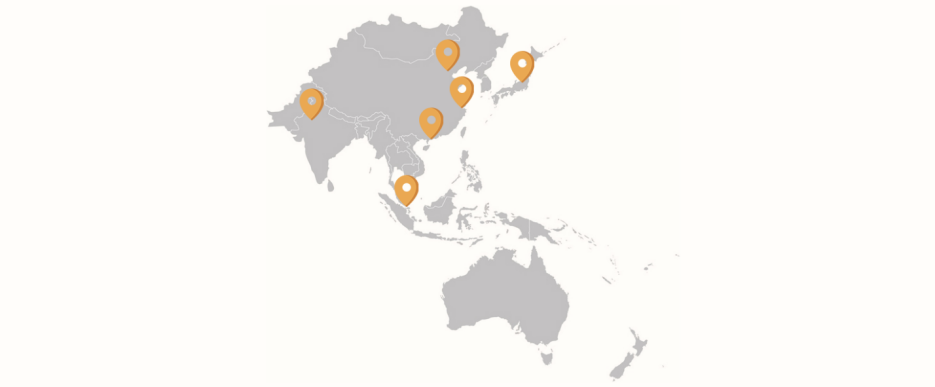
Whether you are looking to exhibit in the high-tech hubs of Shanghai, the medical fairs of Singapore, or the industrial expos of Mumbai, MDfA offers:
》Easier market entry and greater exposure in Asian markets
》Centralized and convenient exhibition and exhibitor services (on-ground coordination, booth execution, and visitor engagement).
》A higher-quality, more efficient business matchmaking platform
View our full exhibition schedule here:
Whether your business is exploring Asia for the first time or expanding existing operations, exhibitions provide a high-impact platform to accelerate opportunities.
Conclusion
Asia’s economic growth in 2026 offers tremendous opportunities for companies willing to proactively adapt to change. Success in these Asian emerging markets requires a blend of data-driven strategy and physical presence. By leveraging the latest Asian market data and engaging directly with the market through professional Asian trade fairs, your brand can secure its place in the world’s most dynamic economic region.
Ready to explore the potential of Asia? Contact MDfA today to learn how our expert trade fair services can accelerate your growth in 2026 and beyond.
References:
1、Six trends to watch in 2026 as Asia-Pacific prepares to overtake North America as the largest consumer market worth $36 trillion in 2035. Available at: https://www.bain.com/about/media-center/press-releases/20252/six-trends-to-watch-in-2026-as-asia-pacific-prepares-to-overtake-north-america-as-the-largest-consumer-market-worth-$36-trillion-in-2035/
2、Asian Development Outlook (ADO) December 2025: Growth Steadies But Uncertainty Lingers. Available at: https://www.adb.org/publications/asian-development-outlook-december-2025
3、Advancing Reforms Can Enhance Prospects – China Economic Update. Available at: https://www.worldbank.org/en/news/press-release/2025/12/11/advancing-reforms-can-enhance-prospects-china-economic-update
4、Southeast Asia quarterly economic review: Markets reshape. Available at: https://www.mckinsey.com/featured-insights/future-of-asia/southeast-asia-quarterly-economic-review
5、RI Govt to break ground on six downstream projects by January end. Available at: https://en.antaranews.com/news/401146/ri-govt-to-break-ground-on-six-downstream-projects-by-january-end